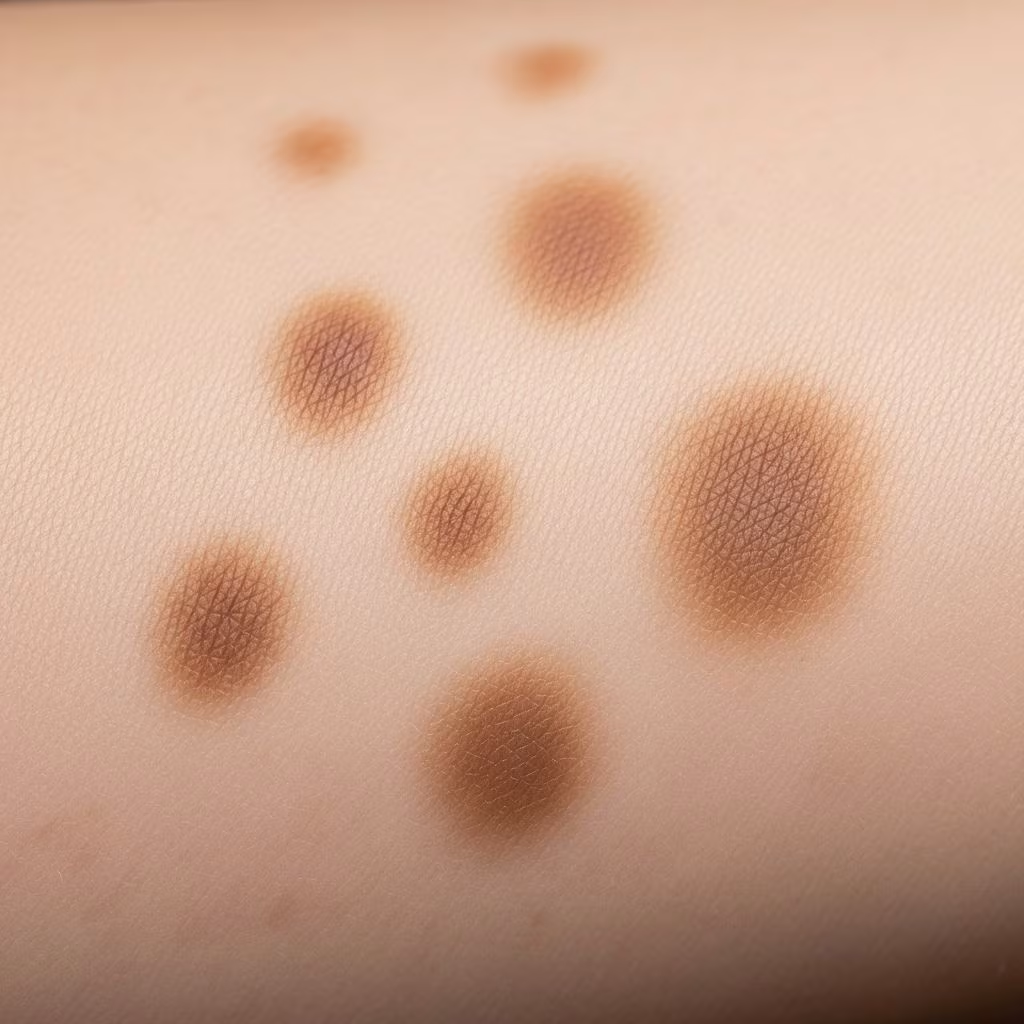
Café-au-lait macules (CALMs) are common, flat, hyperpigmented skin lesions resembling the color of coffee with milk, typically present at birth or appearing in early infancy. These well-circumscribed macules range from light to dark brown and vary in size from a few millimeters to over 20 cm. While often benign and isolated, multiple or large CALMs may signal underlying genetic syndromes such as neurofibromatosis type 1 (NF1).
What are Café-au-Lait Macules?
Café-au-lait macules, also known as CALMs, von Recklinghausen spots, or circumscribed café-au-lait hypermelanosis, are pigmented birthmarks characterized by sharp borders and diameters greater than 0.5 cm. They result from localized melanin accumulation in melanocytes and keratinocytes, leading to hyperpigmentation. The name derives from the French term for “coffee with milk,” accurately describing their creamy light-to-dark brown hue, which contrasts with surrounding skin regardless of ethnicity.
CALMs are congenital or emerge in early infancy, often becoming more prominent after sun exposure. They commonly appear on the trunk and extremities but can occur anywhere on the body. Prevalence varies by race: approximately 0.3% in Caucasians, 0.4% in Chinese, 3% in Hispanics, and up to 8% in African Americans. Isolated CALMs are harmless and do not require treatment, but their presence, number, size, and distribution warrant clinical evaluation for syndromic associations.
Clinical Features
CALMs present as evenly pigmented, oval or irregular macules or patches with smooth or slightly irregular “coast of Maine” borders in syndromic cases (rough) versus smoother “coast of California” in isolated ones. Size typically exceeds 0.5 cm, distinguishing them diagnostically from smaller lentigines. They are asymptomatic, non-tender, and do not elevate above the skin surface.
- Color: Light tan to dark brown, uniform pigmentation.
- Shape and Borders: Oval, round, or geographic; sharp demarcation.
- Size: >0.5 cm up to >20 cm.
- Distribution: Trunk (most common), buttocks, legs; axillae in NF1.
- Number: 1–3 isolated (normal); ≥6 >0.5 cm diagnostic for NF1 in children.
Histologically, CALMs show increased melanin in basal keratinocytes, melanocytic hyperplasia, and giant melanosomes, particularly in NF1-associated lesions.
Images of Café-au-Lait Macules
This gallery showcases diverse clinical presentations of CALMs, aiding in recognition and differentiation. Descriptions highlight key features for educational purposes.
Solitary Café-au-Lait Macule on Trunk
A classic example of an isolated CALM on the lower back of a child: uniform light brown pigmentation, smooth borders, approximately 3 cm in diameter. Present since birth, no associated findings.
Multiple Café-au-Lait Macules in Neurofibromatosis Type 1
Six or more CALMs >0.5 cm across the trunk and extremities, with irregular “coast of Maine” borders. Accompanied by axillary freckling (Crowe sign), indicative of NF1.
Large Café-au-Lait Macule on Buttock
Extensive >10 cm patch on the buttock in McCune-Albright syndrome, often unilateral and following Blaschko lines.
CALMs in Infant
Early infancy presentation: two small macules on the thigh, darkening post-sun exposure.
Syndromic Associations: Legius Syndrome
Multiple small CALMs with facial lentiginosis, mimicking mild NF1 but NF1 gene-negative.
Adult with Isolated CALMs
Stable, non-progressive macules on arms and chest in a 30-year-old, no systemic signs.
(Note: These descriptions represent typical images from clinical sources; actual visuals depict high-resolution dermatoscopic and macroscopic views.)
Associated Syndromes
While most CALMs are isolated, ≥6 lesions >0.5 cm (or ≥3 >1.5 cm in adults) prompt screening for syndromes. Key associations include:
| Syndrome | CALM Features | Other Signs |
|---|---|---|
| Neurofibromatosis Type 1 (NF1) | ≥6 CALMs >0.5 cm, coast of Maine borders | Axillary/inguinal freckling, neurofibromas, Lisch nodules, optic glioma |
| McCune-Albright Syndrome | Large, unilateral, coast of California | Polyostotic fibrous dysplasia, precocious puberty |
| Legius Syndrome | Multiple small CALMs | No tumors, mild NF1-like features |
| Noonan Syndrome with Multiple Lentigines | CALMs + lentigines | Cardiac defects, short stature |
| Silver-Russell Syndrome | CALMs on trunk/extremities | Asymmetry, poor growth, triangular face |
| Bloom Syndrome | CALMs (not diagnostic) | Sun sensitivity, short stature, cancer risk |
| Fanconi Anemia | Multiple CALMs | Bone marrow failure, congenital anomalies |
NF1 is the most common, affecting 1 in 3,000, with 50% sporadic mutations.
Diagnosis
Diagnosis is clinical, based on appearance, size, number, and distribution. Wood lamp accentuates borders. Rule out differentials: lentigines (smaller, irregular), Becker nevus (hypertrichotic), congenital melanocytic nevus (raised, textured). For multiples, perform full exam, family history, ophthalmology referral, and genetic testing (e.g., NF1 gene). NIH criteria for NF1: ≥6 CALMs + ≥1 other feature.
Differential Diagnosis
- Lentigo simplex: Smaller (<0.5 cm), irregular borders.
- Post-inflammatory hyperpigmentation: History of inflammation.
- Nevus spilus: Speckled pigmentation.
- Junctional nevus: Potential malignant transformation risk (unlike CALMs).
Management and Treatment
Isolated CALMs require no intervention; reassure parents of benign nature. Monitor multiples for syndromes via annual exams. Cosmetic laser therapy (Q-switched ruby, Nd:YAG, Alexandrite) can fade lesions but risks repigmentation, hypopigmentation, scarring. Not routinely recommended. Sun protection prevents darkening.
Prognosis
CALMs are permanent but may fade slightly with age. Isolated lesions pose no health risk. Syndromic cases require multidisciplinary management for complications (e.g., NF1 tumors).
Frequently Asked Questions (FAQs)
Are café-au-lait macules cancerous?
No, CALMs themselves are benign and do not become malignant. However, they may indicate syndromes like NF1 with tumor risks.
How many café-au-lait spots indicate neurofibromatosis?
≥6 spots >0.5 cm in children (≥3 >1.5 cm in adults) is a diagnostic criterion for NF1 when combined with other features.
Do café-au-lait macules go away?
Typically permanent, though they may lighten over time. Laser treatment offers fading but recurrence is common.
Can sun exposure affect CALMs?
Yes, UV light darkens them; sunscreen is advised.
Should I worry about a single café-au-lait spot?
A single small spot (<5 cm) is usually harmless and common.
References
- Cafe Au Lait Macules – StatPearls — de SK Jha et al. NCBI Bookshelf. 2023-06-26. https://www.ncbi.nlm.nih.gov/books/NBK557492/
- Café-au-lait macule — DermNet NZ. 2023. https://dermnetnz.org/topics/cafe-au-lait-macule
- Café-au-lait macule — Canadian Skin Patient Alliance. 2023. https://cmsderm.ca/cafe-au-lait-macule/
- What are Café Au Lait Spots — Children’s Tumor Foundation. 2023. https://www.ctf.org/cafeaulait/