
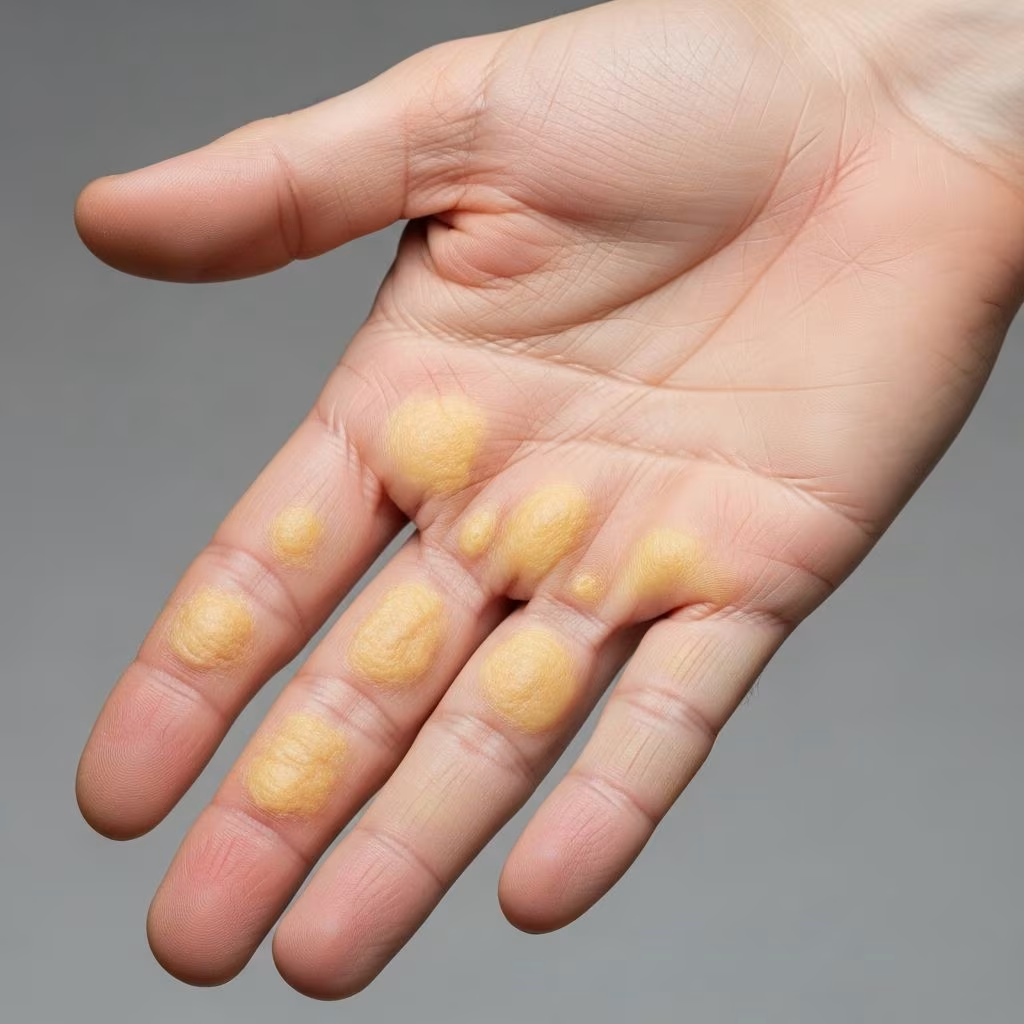
Hereditary focal palmoplantar keratoderma (PPK) refers to a group of rare genetic skin disorders characterized by localized thickening (hyperkeratosis) of the skin on the palms and soles, typically in areas of pressure or friction.
What is hereditary focal palmoplantar keratoderma?
Hereditary focal palmoplantar keratodermas are clinically heterogeneous conditions marked by persistent hyperkeratotic plaques confined to specific sites on the palms and soles, distinguishing them from diffuse or striate forms. These lesions often appear as firm, yellowish-brown callosities over pressure points such as the balls of the feet, heels, and thenar/hypothenar eminences of the palms. Unlike diffuse PPK, which affects the entire palmoplantar surface, focal variants spare surrounding skin and may be asymptomatic or painful depending on location and severity.
The condition typically manifests in infancy or early childhood, though onset can vary by subtype. Histologically, focal PPK shows compact orthokeratotic hyperkeratosis, acanthosis, and hypergranulosis without epidermolysis or vacuolar degeneration, aiding differentiation from epidermolytic forms.
What causes focal keratodermas?
Hereditary focal palmoplantar keratodermas arise from genetic mutations disrupting keratin filament networks or desmosomal proteins essential for epidermal integrity. Most follow autosomal dominant inheritance, where a single mutated allele from one affected parent suffices, though autosomal recessive forms exist.
Key implicated genes include:
- DSG1 (desmoglein 1): Encodes a desmosomal cadherin; heterozygous loss-of-function mutations cause striate/focal PPK with palmoplantar hyperkeratosis and minor nail dystrophy.
- KRT6C and KRT16: Keratin genes; mutations lead to focal non-epidermolytic PPK with painful calluses on weight-bearing areas.
- Other associations: AAGAB and COL14A1 in punctate variants, though focal types overlap.
Sporadic de novo mutations occur without family history. Some focal PPKs form syndromes with extracutaneous features, linking to internal organ abnormalities.
Types of hereditary focal palmoplantar keratoderma
Numerous subtypes exist, often overlapping clinically but distinguished by genetics, associated features, and inheritance.
| Type | Key Features | Gene/Inheritance | Associations |
|---|---|---|---|
| PPK striata/areata type | Linear/striate hyperkeratosis on palms, flexural involvement | DSG1/AD | Nail changes |
| Howel-Evans syndrome | Focal PPK + esophageal cancer risk | Tylosis, oral leukoplakia | |
| Richner-Hanhart syndrome | Focal yellow plaques, corneal dystrophy | TAT/AR | Tyrosinemia II |
| Pachyonychia congenita | Focal PPK + thick nails, mucosal lesions | KLHL1 (KRT6A/B/C, KRT16/17)/AD | Oral cysts, hoarseness |
| Striate PPK with woolly hair & cardiomyopathy | Striate PPK, hair abnormalities, cardiac issues | DSG1 or DSP/AD | Dilated cardiomyopathy |
| Focal PPK with joint keratoses | PPK + knuckle/joint hyperkeratosis | Unknown/AD | Joint involvement |
Howel-Evans syndrome (tylosis with esophageal cancer) exemplifies syndromic focal PPK, with 95% lifetime risk of squamous cell carcinoma. Richner-Hanhart features painful corneal erosions from tyrosinemia.
Clinical features
Focal lesions present as well-demarcated, hyperkeratotic plaques (1-3 cm) on pressure sites: metatarsal heads, heels, palms’ ridges. Characteristics include:
- Yellow-brown color, fissuring, koebnerization from trauma.
- Pain/tenderness in weight-bearing areas, secondary infection risk.
- Transgrediens (extension beyond palms/soles) or nail dystrophy in some.
- Syndromic: Cancer predisposition (Howel-Evans), metabolic (Richner-Hanhart), cardiac (woolly hair type).
Progression varies; untreated plaques hypertrophy, impairing mobility.
Diagnosis
Diagnosis combines clinical exam, family history, and histopathology; genetic testing confirms subtype.
- History/Exam: Early onset, focal distribution, positive family history.
- Histology: Punch biopsy reveals non-epidermolytic hyperkeratosis.
- Genetics: Targeted sequencing (DSG1, KRT6C, etc.); NGS panels for syndromic cases.
- Differential: Acquired PPK (psoriasis, malignancy), punctate PPK, epidermolytic types.
Syndromic screening: Endoscopy (Howel-Evans), tyrosine levels (Richner-Hanhart).
Treatment and prognosis
No cure exists; management targets symptom relief and prevention.
Topical therapies
- Keratolytics: Urea (20-40%), salicylic acid (6-20%) creams soften plaques; apply under occlusion.
- Emollients: Daily petrolatum-based to hydrate.
Systemic therapies
- Retinoids: Acitretin (0.5-1 mg/kg/day) reduces hyperkeratosis; monitor lipids/hepatic function.
- Tyrosine restriction: For Richner-Hanhart.
Physical/Other
- Debridement, custom orthotics for pressure relief.
- Cryotherapy/laser for resistant lesions.
- Cancer surveillance in high-risk types.
Prognosis: Cosmetic/functional improvement with adherence; syndromic forms carry morbidity from associations.
Frequently Asked Questions (FAQs)
Q: Is hereditary focal PPK contagious?
A: No, it is a genetic condition, not infectious.
Q: At what age does focal PPK appear?
A: Typically infancy to early childhood, varying by subtype.
Q: Can focal PPK be cured?
A: No cure, but treatments control symptoms effectively.
Q: Does focal PPK increase cancer risk?
A: Yes, in subtypes like Howel-Evans (esophageal cancer).
Q: How is focal PPK inherited?
A: Mostly autosomal dominant; some recessive.
References
- Hereditary focal palmoplantar keratoderma — DermNet NZ. 2023. https://dermnetnz.org/topics/hereditary-focal-palmoplantar-keratoderma
- Palmoplantar Keratoderma I, Striate, Focal, or Diffuse — Montefiore Einstein. 2024. https://montefioreeinstein.org/new-york-center-for-rare-diseases/conditions/blood-immunity-disorders/palmoplantar-keratoderma-i
- Diagnosis and Management of Inherited Palmoplantar Keratodermas — PMC (PubMed Central). 2022-05-12. https://pmc.ncbi.nlm.nih.gov/articles/PMC9128927/
- How To Diagnose And Manage Hereditary Palmoplantar Keratodermas — HMP Global Learning Network. 2023. https://www.hmpgloballearningnetwork.com/site/podiatry/how-diagnose-and-manage-hereditary-palmoplantar-keratodermas
- Palmoplantar Keratodermas — Foundation for Ichthyosis & Related Skin Types. 2024. https://www.firstskinfoundation.org/types-of-ichthyosis/palmoplantar-keratodermas
- Palmoplantar keratoderma — Primary Care Dermatology Society (PCDS). 2023. https://www.pcds.org.uk/clinical-guidance/keratoderma
- Focal palmoplantar keratoderma with joint keratoses — GARD (NIH Genetic and Rare Diseases). 2024. https://rarediseases.info.nih.gov/diseases/17596/focal-palmoplantar-keratoderma-with-joint-keratoses