
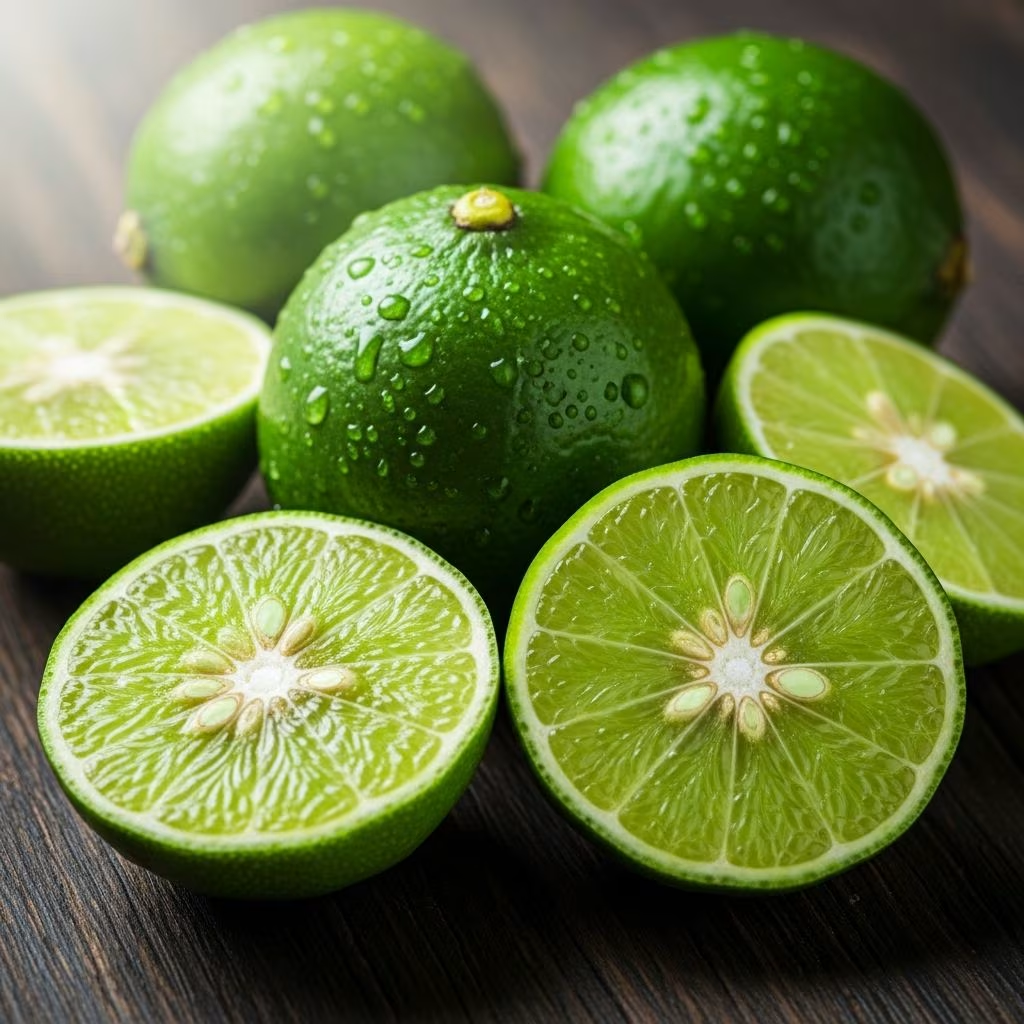
Author: Dr Marius Rademaker, Department of Dermatology, Waikato Hospital, Hamilton, New Zealand. Updated 1999, reviewed and edited by DermNet content department.
What is lime?
The lime commonly refers to the Tahitian lime or Persian lime (*Citrus latifolia*), a seedless citrus fruit prized for its tangy flavor and versatile uses in cooking, beverages, and cosmetics. Unlike the smaller Key lime or Mexican lime, the Tahitian lime produces larger, oval fruits with thin, smooth green skin that turns yellow when ripe. This hybrid citrus is nearly thornless and thrives in subtropical climates.
Limes belong to the Rutaceae family, which includes other citrus species like lemons, oranges, and grapefruits. They are rich in vitamin C and citric acid, contributing to their sour taste and preservative properties. Beyond culinary applications, lime peel oils contain potent compounds that can trigger skin reactions, particularly phytophotodermatitis—a non-immunologic phototoxic response combining plant chemicals with ultraviolet light exposure.
Origin and history
The exact origin of the Tahitian lime remains uncertain, but it is widely presumed to be a hybrid of the Mexican lime (*Citrus aurantiifolia*) and the citron (*Citrus medica*), or possibly the lemon. Genetic studies suggest its roots trace back to Northeast India and Southeast Asia, regions considered the cradle of citrus cultivation. From there, it spread via ancient trade routes.
Historical records indicate introduction to the Mediterranean through Iran (ancient Persia), earning it the name Persian lime. Portuguese traders likely transported it to Brazil in the 16th century, and from Brazil, it reached Australia around 1824. Today, major production occurs in Mexico, Brazil, the United States (Florida and California), and Egypt, supplying global markets year-round.
Description of the lime tree and fruit
The Tahiti lime tree is a moderately vigorous, evergreen grower reaching 4.5–6 meters in height with widespread, drooping branches that create a broad canopy. It features nearly thornless stems, distinguishing it from wilder citrus relatives. Leaves are broad-lanceolate with distinctive winged petioles, and young shoots display a purplish hue. Flowers bloom year-round, small and slightly purple-tinged, producing a subtle fragrance.
The fruit is oval, obovate, oblong, or short-elliptical, measuring 4–6.25 cm wide and 5–7.5 cm high. It has a rounded base, sometimes ribbed or with a short neck, and a nipple-like apex. The peel is vivid green when unripe, turning pale yellow at maturity; it is smooth, thin, and tightly clinging. Inside, the pulp is light greenish-yellow, divided into 10 tender segments with high acidity but lacking the aromatic bouquet of Mexican limes. Notably, Tahiti limes are usually seedless, and their flowers produce no viable pollen, making them reliant on grafting for propagation.
| Characteristic | Description |
|---|---|
| Tree height | 4.5–6 m, thornless branches |
| Leaves | Broad-lanceolate, winged petioles |
| Fruit size | 4–6.25 cm wide, 5–7.5 cm high |
| Peel | Smooth, thin, green to yellow |
| Pulp | 10 segments, seedless, acidic |
Uses of limes
Limes serve multiple purposes across food, cosmetics, and household applications. Primarily, they act as a food source, with juice enhancing flavors in beverages like margaritas, mojitos, and limeade, as well as in ceviche, salads, and marinades. The peel is grated for zest in baking, confectionery, and essential oils extraction for perfumes and cleaners.
- Culinary: Juice for drinks, dressings, and preserves; peel for zest and oils.
- Cosmetic: Peel extracts in lotions, shampoos, and freshening rinses.
- Household: Juice cleans coffeepots, removes calcium deposits in kettles, and deodorizes waste disposals.
In hair care, lime juice rinses add shine post-shampooing. Some use it to lighten hair streaks via sun exposure (with caution to avoid peel oil). Dilute juice effectively dissolves mineral buildup overnight.
Allergens in limes
Lime peel oils harbor several potent allergens and phototoxins, primarily:
- d-limonene: A monoterpene causing irritant contact dermatitis.
- geraniol and citral: Fragrance compounds linked to allergic reactions.
- Furocoumarins: Including limettin, bergapten, isopimpinellin, xanthotoxin, and psoralen—the key triggers for phototoxicity. Limettin predominates, followed by bergapten.
These compounds concentrate in the peel, especially when limes are rolled or squeezed, transferring oil to skin.
Allergic and phototoxic reactions to limes
Exposure to lime peel oil poses risks of phototoxic dermatitis, urticaria, and contact dermatitis. Rolling limes between hands before juicing coats skin with oil, which spreads to touched areas. Subsequent sunlight exposure (UVA rays) activates furocoumarins, causing phytophotodermatitis: streaky brown or red hyperpigmented patches that itch intensely, often with blisters resembling burns.
This manifests as berloque dermatitis, historically linked to bergamot but applicable to lime (Citrus bergamia variant). Reactions appear 24–48 hours post-exposure, peaking at 72 hours. Sap from tree branches or thorn scratches can also irritate sensitive skin. Rare reports include asthma or hayfever from lime pollen.
Severe cases, like mojito-induced phytophotodermatitis from lime juice splashes during mixing followed by sun exposure, highlight real-world risks. Early recognition involves cooling compresses, topical steroids, and sun protection to prevent prolonged hyperpigmentation.
Cross-reactions
Individuals reactive to Tahiti lime may cross-react with Mexican lime (*C. aurantiifolia*) and other Citrus species (e.g., lemon, orange, grapefruit) due to shared furocoumarins and limonene. Patch testing confirms sensitivity: apply lime peel oil diluted 1–10% in petrolatum, read at 48–96 hours.
| Related Citrus | Common Allergens | Risk Level |
|---|---|---|
| Mexican lime | Furocoumarins, limonene | High |
| Lemon | Citral, psoralen | Moderate |
| Orange | Limonene | Moderate |
Prevention and management
To avoid reactions:
- Wash hands thoroughly after handling limes, especially before sun exposure.
- Avoid rolling limes; cut directly to minimize peel oil transfer.
- Use gloves for juicing or zesting.
- Apply sunscreen over juice-exposed skin, though furocoumarins penetrate it.
- For hair lightening, ensure no peel oil residue.
Treatment includes emollients, potent topical corticosteroids for inflammation, and oral antihistamines for itch. Blisters require non-stick dressings; severe cases may need oral steroids. Hyperpigmentation fades over months with sun avoidance.
Other information
Lime juice’s acidity makes it a natural cleaner: it dissolves limescale in kettles overnight and neutralizes odors in garbage disposals. In folklore, it’s an antidote for oral irritation from aroids like Dieffenbachia, providing quick relief.
Frequently asked questions
What causes lime-induced skin burns?
Lime peel oils containing furocoumarins react with UVA light, causing phytophotodermatitis—blisters and hyperpigmentation.
Is lime safe for cooking?
Yes, juice is safe internally; risks stem from peel oil on skin plus sun.
How to test for lime allergy?
Patch testing with diluted peel oil; consult a dermatologist.
Can lime lighten hair safely?
Juice can bleach via sun, but avoid peel oil to prevent dermatitis.
Does lime affect everyone?
No, mainly those handling peel oils and exposed to sun; sensitivity varies.
References
- Limes — DermNet NZ. 1999 (reviewed). https://dermnetnz.org/topics/lime
- CHASHNIt for enhancing skin disease classification using GAN augmented hybrid model with LIME and SHAP based XAI heatmaps — Saksham Anand et al., Vellore Institute of Technology. 2024. https://pmc.ncbi.nlm.nih.gov/articles/PMC12375737/
- Food Additives and E Numbers — DermNet NZ. Recent. https://dermnetnz.org/topics/food-additives-and-e-numbers
- Mojito-induced Phytophotodermatitis: A Case of Lime-triggered Skin Reaction — Karger Publishers. 2024. https://karger.com/cde/article-pdf/doi/10.1159/000547675/4415435/000547675.pdf