
Revised: January 2026
What is melioidosis?
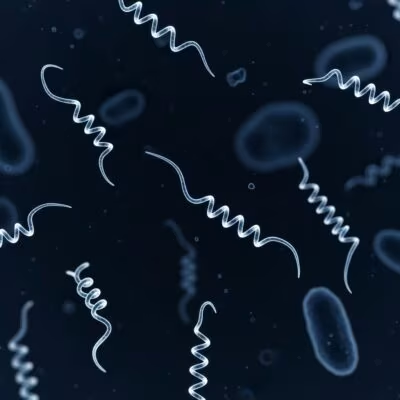
Melioidosis, also known as Whitmore’s disease or the ‘great mimicker,’ is a potentially life-threatening bacterial infection caused by Burkholderia pseudomallei, a Gram-negative, aerobic, motile bacillus found in soil and stagnant water in endemic tropical regions such as Southeast Asia, northern Australia, and parts of South America. The disease can present acutely or chronically, ranging from localized skin abscesses to fulminant sepsis with multi-organ failure, often mimicking tuberculosis, pneumonia, or other infections. Symptoms typically emerge 1–4 weeks post-exposure, though latent infections may manifest years later.
Endemic in over 45 countries, melioidosis thrives in monsoon-prone areas where heavy rainfall contaminates water sources. Risk factors include diabetes (present in ~50% of cases), chronic lung/kidney disease, alcohol abuse, and immunosuppression. In non-endemic regions like the US, cases often link to travel or importation of contaminated products. The bacterium’s resilience—surviving desiccation, disinfectants, and antibiotics—makes it a CDC Category B bioterrorism agent.
Who gets melioidosis?
Anyone exposed to contaminated soil or water can contract melioidosis, but certain groups face higher risk:
- Individuals with diabetes mellitus: Accounts for 40–60% of cases due to impaired immunity.
- Chronic conditions: Lung disease (e.g., COPD), kidney failure, thalassaemia, cancer.
- Occupational exposure: Farmers, rice paddy workers, gardeners in endemic areas.
- Children and elderly: Higher vulnerability, especially during monsoons.
- Travelers/importers: Cases reported in non-endemic areas from imported soil/palms.
In Australia and Thailand, diabetes triples infection risk. Subclinical infections occur in ~4% of exposed populations, with reactivation possible under stress.
What causes melioidosis?
B. pseudomallei enters via cutaneous abrasions, inhalation of aerosols, or ingestion of contaminated water. Percutaneous inoculation is most common (60% of cases), followed by inhalation (20–30%), especially during storms. The bacterium evades phagocytosis, forms biofilms, and expresses virulence factors like exopolysaccharides, enabling intracellular survival and dissemination.
No human-to-human transmission occurs routinely, though rare cases via direct contact exist. Animal reservoirs (e.g., goats in glanders) are unrelated.
What are the clinical features of melioidosis?
Melioidosis manifests in diverse forms: localized (20%), pulmonary (50%), bacteremic (40–60%), septic shock (20%), or chronic (>2 months, 11%). Incubation averages 9 days (1–21 days acute; longer latent).
Localized infection
Skin ulcers, nodules, or abscesses at entry site, with fever and myalgias.
Pulmonary melioidosis
Most common: cough (productive/nonproductive), high fever, chest pain, mimicking TB on X-ray (upper lobe infiltrates, cavitation).
Bacteremic/septic form
Fever, headache, respiratory distress, abdominal/chest pain, myalgias, disorientation, seizures; leads to shock.
Deep organ abscesses
Spleen (most common), liver, prostate (chronic), parotid, joints/bones, lymph nodes, brain.
| Clinical Form | Frequency | Key Symptoms |
|---|---|---|
| Pulmonary | 50% | Cough, fever, chest pain |
| Bacteremic | 40–60% | Sepsis, multi-organ failure |
| Abscess (visceral/skin) | 20–30% | Localized pain, fever |
| Neurologic | 5–10% | Encephalitis, abscess |
Chronic form resembles TB with weight loss, indolent abscesses.
How is melioidosis diagnosed?
Diagnosis relies on culture confirmation from blood, sputum, pus, urine, or swabs, as symptoms are nonspecific. Serology detects antibodies but has cross-reactivity/false negatives in early disease. PCR aids rapid detection.
- Culture: Gold standard; yields from multiple sites improve sensitivity.
- Imaging
X-ray/CT: Pneumonia, abscesses. - Lab: Leukocytosis, elevated CRP/procalcitonin.
Differential: TB, plague, cat-scratch disease, pneumonia, sepsis. Empirical treatment urged in endemic areas for fever + risk factors.
What is the treatment for melioidosis?
Two-phase antibiotics: intensive IV (2–8 weeks) then eradication oral (3–6 months). Non-adherence risks relapse (within 1–2 years).
Intensive phase
- Ceftazidime IV q6–8h (or continuous) OR Meropenem q8h (severe/CNS/bone).
- Add TMP-SMX PO for focal non-pulmonary.
Eradication phase
- TMP-SMX + folic acid q12h (first-line) OR Amox-clav q8h OR Doxycycline.
Supportive: Drain abscesses, fluids, ventilation. Mortality 10–20% with treatment; 40–90% untreated. Worse in diabetics/delayed care.
What are the complications of melioidosis?
Sepsis, septic shock, ARDS, multi-organ failure, abscesses (prostate recurrence common), relapse (6%), chronic suppuration. Long-term: ~10% mortality post-discharge; sequelae like bronchiectasis.
How can melioidosis be prevented?
- Avoid contact with soil/water in endemic areas: Wellingtons during monsoons, protective gear for workers.
- No vaccine available.
- Early wound cleaning; report travel history.
Related topics
- Glanders
- Cat scratch disease
- Plague
- Tuberculosis
Frequently asked questions
Q: Is melioidosis contagious?
A: No routine person-to-person spread; acquired from environment.
Q: How long does treatment last?
A: IV 2–8 weeks + oral 3–6 months.
Q: Can melioidosis recur?
A: Yes, if eradication incomplete; monitor 2 years.
Q: Is there a vaccine?
A: No, prevention via exposure avoidance.
Q: Who is at highest risk?
A: Diabetics, immunocompromised in tropics.
References
- Clinical Overview of Melioidosis — Centers for Disease Control and Prevention (CDC). 2024. https://www.cdc.gov/melioidosis/hcp/clinical-overview/index.html
- Melioidosis — DermNet NZ. 2024. https://dermnetnz.org/topics/melioidosis
- Melioidosis: Causes, Symptoms, Transmission & Treatment — Cleveland Clinic. 2024. https://my.clevelandclinic.org/health/diseases/24051-melioidosis
- About Melioidosis — Centers for Disease Control and Prevention (CDC). 2024. https://www.cdc.gov/melioidosis/about/index.html
- Melioidosis Fact Sheet — Pennsylvania Department of Health (.gov). 2023. https://www.pa.gov/content/dam/copapwp-pagov/en/health/documents/topics/documents/diseases-and-conditions/Melioidiosis.pdf
- Melioidosis — Nature Reviews Disease Primers (PMC). 2019-03-29. https://pmc.ncbi.nlm.nih.gov/articles/PMC6456913/

Medha Deb
Health WriterThis article is for general informational purposes only and is not a substitute for professional medical advice, diagnosis, or treatment. Always seek the advice of a qualified healthcare provider with questions about a medical condition.