
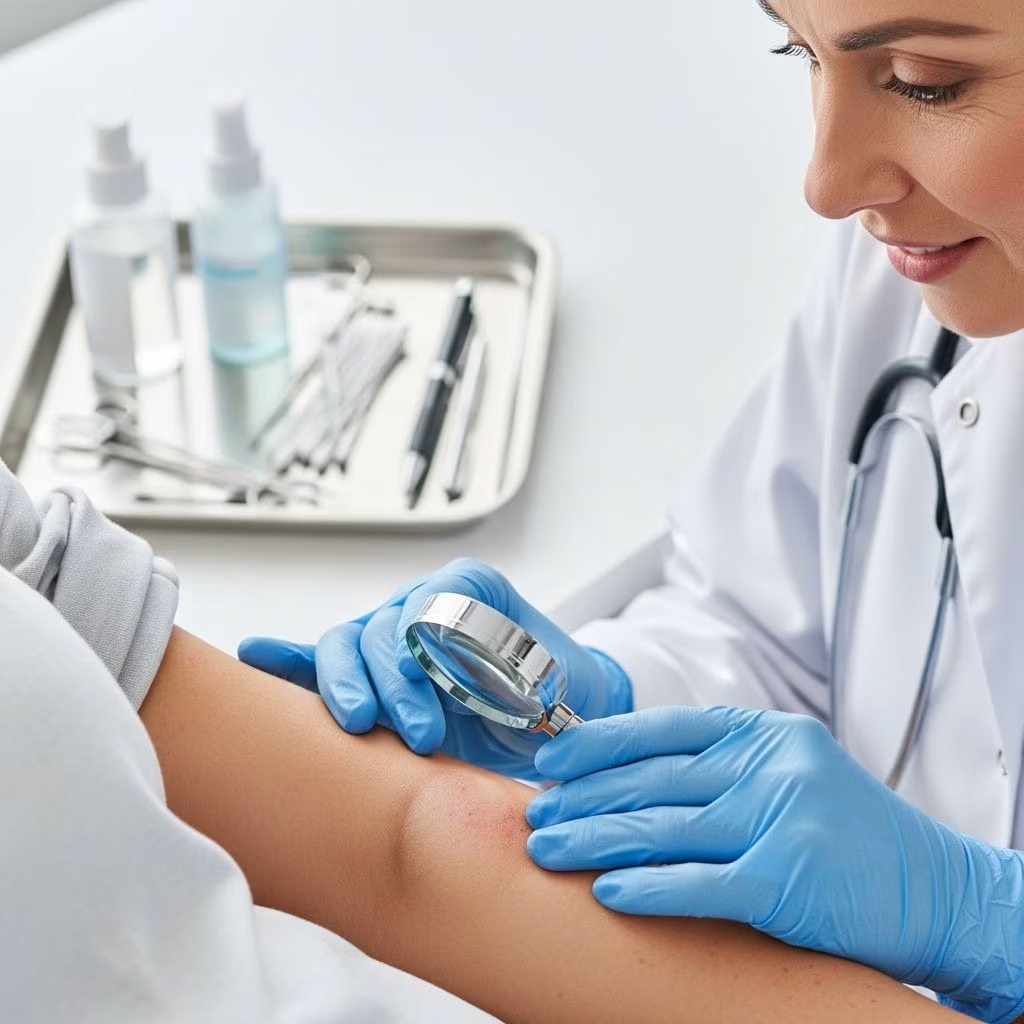
Psoriasis is a chronic inflammatory skin condition affecting millions worldwide, with effective management relying on tailored therapeutic strategies. This guide summarises key recommendations for treating chronic plaque psoriasis, drawing from established protocols relevant to New Zealand practice.
Acknowledgement
This article incorporates insights from leading sources including the National Institute for Health and Care Excellence (NICE) guidelines, UpToDate reviews, and the New Zealand Formulary, ensuring evidence-based recommendations for psoriasis management.
Introduction
Psoriasis is a lifelong condition without a cure, but it is highly treatable with appropriate interventions. Successful outcomes depend on patient education regarding the chronic nature of the disease and available therapies. Key goals include achieving a body surface area (BSA) involvement of ≤3% or ≥75% improvement from baseline within 3 months of starting treatment, with an ideal target of BSA ≤1% maintained every 6 months during therapy. Treatments range from topical agents for mild cases to systemic biologics for severe disease, always considering patient preferences, comorbidities, and response.
Demographics
Psoriasis affects approximately 2-3% of the global population, with similar prevalence in New Zealand. It commonly onset in adulthood (20-40 years), though childhood cases occur. Men and women are equally impacted, and genetic factors play a significant role, with higher incidence in those with family history. In NZ, public dermatology services face workforce shortages, influencing access to specialist care.
Causes
Psoriasis arises from a complex interplay of genetic predisposition, immune dysregulation, and environmental triggers. T-cell mediated inflammation drives rapid keratinocyte proliferation, leading to plaque formation. Triggers include streptococcal infections, stress, smoking, alcohol, obesity, and medications like beta-blockers or lithium. Genome-wide studies identify over 80 susceptibility loci, emphasising heritability.
Clinical Features
Classic chronic plaque psoriasis presents as well-demarcated erythematous plaques with silvery scales, typically on extensor surfaces (elbows, knees), scalp, and nails. Lesions vary in size; mild disease affects <3% BSA, moderate 3-10%, severe >10%. Variants include scalp, flexural, guttate, pustular, and erythrodermic forms. Symptoms encompass itching, pain, and joint involvement in psoriatic arthritis (up to 30% of cases).
Complications
Beyond skin, psoriasis increases risks of cardiovascular disease, metabolic syndrome, diabetes, depression, and inflammatory bowel disease. Severe forms like generalised pustular psoriasis can be life-threatening due to dehydration, sepsis, or organ failure. Nail psoriasis leads to onycholysis and pitting; scalp involvement causes significant psychosocial distress.
Diagnosis
Diagnosis is clinical, based on characteristic morphology. Skin biopsy is rarely needed but shows parakeratosis, Munro microabscesses, and dilated capillaries. Assess BSA, Psoriasis Area and Severity Index (PASI), and Dermatology Life Quality Index (DLQI) for severity. Screen for comorbidities via lipid profile, blood glucose, liver function, and joint exam.
Assessment
Initial evaluation includes history (triggers, previous treatments), physical exam (BSA, PASI score), and comorbidity screening. Stratify severity: mild (<3% BSA), moderate (3-10%), severe (>10% or DLQI >10). Patient education on adherence is crucial. Regular follow-up targets BSA ≤1%.
Differential Diagnoses
Common mimics include eczema, lichen planus, tinea corporis, seborrhoeic dermatitis, cutaneous lupus, and mycosis fungoides. Scalp psoriasis may resemble dandruff; flexural types mimic candidiasis. Biopsy resolves ambiguities.
Treatment
Treatment escalates based on severity, location, and response. Lifestyle modifications—emollients, smoking cessation, alcohol reduction, weight management—are foundational.
Topical Therapy (First-line for Mild-Moderate)
Emollients restore barrier function, reducing scaling and itch. Keratolytics (salicylic acid 3-6%, urea 10%) soften thick plaques. Corticosteroids (potent for trunk/limbs, mild for face/flexures) provide rapid relief; combine with vitamin D analogues (calcipotriol) for synergy, e.g., calcipotriol/betamethasone foam (Enstilar®). Calcineurin inhibitors (tacrolimus) suit sensitive areas. Newer agents: roflumilast 0.3% cream, tapinarof 1% cream (FDA-approved 2022). Use occlusion for stubborn plaques.
For scalp psoriasis, shampoos with coal tar or corticosteroids; foams/sprays enhance compliance. Genital psoriasis requires mild steroids or calcitriol.
Phototherapy
Narrowband UVB (NB-UVB) is first-line for moderate disease, slowing keratinisation and T-cell activity. Combine with topicals. PUVA (psoralen + UVA) for thicker plaques. Sessions 2-3x/week; monitor for burns, skin cancer risk.
Systemic Non-Biologic Therapy
Indicated for moderate-severe psoriasis failing topicals/phototherapy. Options:
- Methotrexate (7.5-25mg/week): Hepatotoxicity monitoring essential.
- Ciclosporin (2.5-5mg/kg/day): Short-term (3-6 months) due to nephrotoxicity.
- Acitretin (25-50mg/day): For pustular/erythrodermic; teratogenic.
- Hydroxycarbamide (1-2g/day): Alternative for contraindications.
Adjunct topicals optimise outcomes; specialist initiation required.
Biologic Therapy
For severe/refractory cases or psoriatic arthritis. Targets IL-17, IL-23, TNF-α:
| Agent | Target | Dosing | Key Notes |
|---|---|---|---|
| Secukinumab, Ixekizumab | IL-17A | 300mg SC monthly | Rapid PASI75; candida risk. |
| Guselkumab, Risankizumab | IL-23 | 100mg SC at weeks 0,4, then 12-weekly | Long-term maintenance. |
| Adalimumab, Etanercept | TNF-α | 40mg SC every 2 weeks/50mg weekly | Infection screening. |
| Ustekinumab | IL-12/23 | 45-90mg SC at 0,4, then yearly | Weight-based. |
Screen for TB/hepatitis; highly effective (PASI90 in 70-90%).
Referral Criteria
- BSA >10% or PASI >10 with DLQI >10.
- Failed topical/phototherapy.
- Special sites (face, genitals, palms/soles).
- Psoriatic arthritis, pustular/erythrodermic forms.
- Systemic therapy candidacy.
Special Populations
Pregnancy: Topicals preferred; avoid retinoids, methotrexate. Paediatrics: Calcipotriol + mild steroid. Comorbidities guide choices (e.g., no ciclosporin in hypertension).
Outcome
With adherence, 70-80% achieve control with topicals; systemic/biologics yield remission in severe cases. Relapse common upon cessation; maintenance (e.g., weekend steroid + calcipotriol) prevents flares. Multidisciplinary care improves quality of life.
Frequently Asked Questions (FAQs)
Q: What is the first-line treatment for mild psoriasis?
A: Topical emollients, corticosteroids, and vitamin D analogues like calcipotriol, often in combination.
Q: When should biologics be considered?
A: For severe psoriasis unresponsive to conventional therapies, achieving superior PASI responses.
Q: Is phototherapy safe long-term?
A: NB-UVB is effective with low risk; monitor for skin cancer, limit cumulative dose.
Q: Can psoriasis be cured?
A: No, but it can be effectively managed to near-clearance with ongoing therapy.
Q: How to manage scalp psoriasis?
A: Topical steroids/coal tar shampoos; foams for ease; escalate to systemic if widespread.
References
- Guidelines for the management of psoriasis — DermNet NZ. 2023. https://dermnetnz.org/topics/guidelines-for-the-treatment-of-psoriasis
- Scalp Psoriasis: A Complete Overview — DermNet NZ. 2023. https://dermnetnz.org/topics/scalp-psoriasis
- Psoriasis: Symptoms, Treatment, Images and More — DermNet NZ. 2023. https://dermnetnz.org/topics/psoriasis
- Treatment of psoriasis — DermNet NZ. 2023. https://dermnetnz.org/topics/treatment-of-psoriasis
- Guidelines of care for the management and treatment of psoriasis with topical therapies — American Academy of Dermatology (via ResearchReview NZ). 2019. https://www.researchreview.co.nz/getmedia/46f52bab-f1ec-4ef8-82cf-b72ebcee7f3f/Educational-Series-Psoriasis-Management_1.pdf.aspx?ext=.pdf
- Chronic plaque psoriasis: an overview of treatment in primary care — bpac.org.nz. 2017. https://bpac.org.nz/2017/psoriasis-1.aspx