
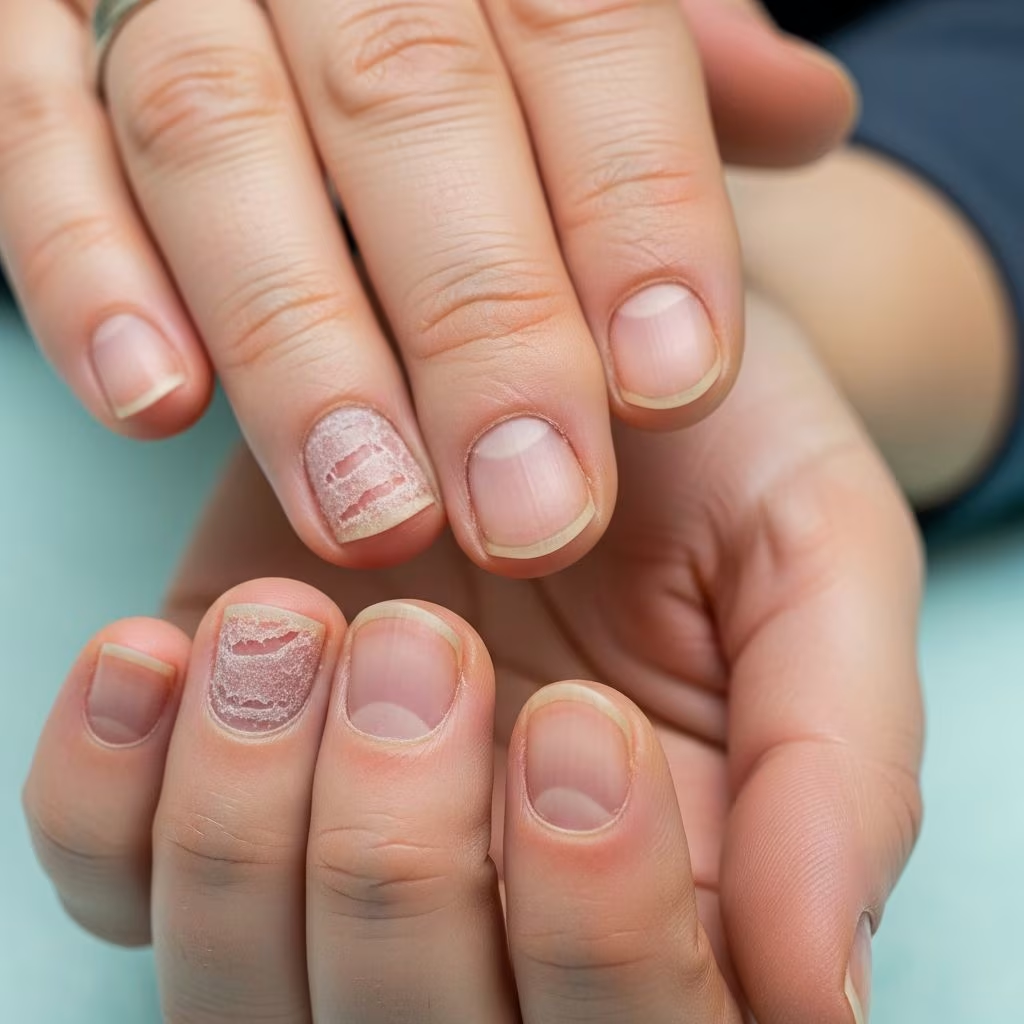
Authoritative facts about trachyonychia (rough nails or twenty-nail dystrophy): what it looks like, causes, who gets it, diagnosis, treatment, and prognosis.
What is trachyonychia?
Trachyonychia, also known as twenty-nail dystrophy or rough nails, is a nail abnormality characterized by brittle, thin nails with diffuse longitudinal ridging. The nail plate surface resembles fine sandpaper due to excessive longitudinal striations running parallel to the nail edge. It affects any number of nails but is most commonly seen on all fingernails and toenails, hence the term twenty-nail dystrophy.
The condition can present in two main clinical varieties: opaque (severe) and shiny (mild). Fingernails are affected more frequently than toenails, and the severity varies between nails and patients. Trachyonychia is typically benign and non-scarring, often improving spontaneously, especially in children.
Who gets trachyonychia?
Trachyonychia affects individuals of all ages, but it is most common in children and young adults. It shows no strong gender preference, though some reports note a slight male predominance in childhood cases. Rare familial cases have been documented, including autosomal dominant inheritance and occurrences in identical twins, suggesting a genetic component in some instances.
- Prevalence is unknown but considered uncommon.
- Isolated cases (idiopathic) are frequent in children.
- Associated forms occur across all age groups depending on underlying conditions.
What causes trachyonychia?
The exact pathogenesis of trachyonychia is unclear, but inflammation in the nail matrix is hypothesized to play a central role. The extent and persistence of this inflammation determine disease severity: severe, diffuse inflammation leads to opaque nails, while mild, intermittent inflammation causes shiny variants.
Trachyonychia can be:
- Idiopathic: No underlying cause identified, most common in children.
- Associated with other conditions: Linked to various dermatological, systemic, or autoimmune disorders.
Common associations
| Category | Examples |
|---|---|
| Dermatological | Alopecia areata, psoriasis, lichen planus, atopic dermatitis, pityriasis rubra pilaris |
| Systemic/Immunological | Immunoglobulin A deficiency, graft-versus-host disease |
| Other | Ichthyosis vulgaris, reactive after hand-foot-mouth disease |
In many cases, especially idiopathic trachyonychia, no skin lesions or systemic symptoms are present. When associated with lichen planus or psoriasis, nail matrix involvement predominates without typical skin findings.
What does trachyonychia look like?
Clinically, trachyonychia manifests as rough, thin, brittle nails with prominent longitudinal ridging. Additional features include:
- Loss of nail lustre (opaque type) or retained shine (shiny type)
- Superficial scaling of the nail plate
- Hyperkeratosis and ragged cuticles
- Koilonychia (spoon-shaped nails)
- Onychoschizia (nail splitting)
- Distal notching or fragility in advanced cases
Opaque variety (severe)
Nails appear dull, opaque, and sandpaper-like with excessive longitudinal ridging from fine, parallel superficial striations. This reflects diffuse nail matrix damage from persistent inflammation.
Shiny variety (mild)
Nails retain luster with superficial ridging and multiple small geometric pits. This multifocal pattern arises from intermittent matrix inflammation.
Images typically show uniformly affected nails with varying roughness; fingernails predominate.
How is trachyonychia diagnosed?
Diagnosis is primarily clinical, based on characteristic nail morphology. Key features include brittle nails with longitudinal ridging, with or without pitting.
- No specific test confirms idiopathic trachyonychia.
- Biopsy if underlying cause suspected: shows spongiosis, exocytosis of inflammatory cells in nail epithelium; may mimic psoriasis or lichen planus.
- Histopathology more prominent in proximal nail matrix and ventral fold, explaining dorsal plate changes.
Differential diagnosis includes onychomycosis, nail psoriasis, eczema, or contact dermatitis. Rule out infections via microscopy/culture.
Treatment for trachyonychia
Trachyonychia is chronic but benign, often managed for cosmetic reasons only. Many cases, especially idiopathic childhood onset, improve spontaneously within 6 years (50% resolution rate).
Conservative measures
- Moisturize nails/cuticles with petrolatum or urea creams.
- Avoid trauma; use protective gloves.
- Biotin supplements (2.5–10 mg/day) may strengthen nails, though evidence limited.
Topical therapies
- High-potency corticosteroids (e.g., clobetasol 0.05%) under occlusion: 20–40% improvement in some series.
- Tacrolimus 0.1% ointment: Useful for associated inflammatory conditions.
Systemic therapies (refractory cases)
- Systemic steroids or methotrexate for lichen planus/psoriasis-associated cases.
- Treatment targets underlying cause when identified.
No curative treatment exists; focus on symptom relief. Persistent cases (>6 years) less likely to resolve spontaneously.
What is the prognosis for trachyonychia?
Prognosis is excellent: non-scarring, painless, and often self-limited. Idiopathic cases in children frequently resolve by adolescence. Associated forms depend on underlying disease management. Recurrence possible, but most achieve normal nails over time.
Frequently Asked Questions (FAQs)
Q: Is trachyonychia dangerous?
A: No, it is benign, non-scarring, and painless, posing no health risks beyond cosmetics.
Q: Does trachyonychia affect toenails?
A: Yes, but fingernails are more commonly and severely affected.
Q: Can trachyonychia be cured?
A: Not always curable, but many cases resolve spontaneously, especially in children.
Q: Should I see a doctor for trachyonychia?
A: Consult a dermatologist for diagnosis and to exclude associated conditions like psoriasis or alopecia areata.
Q: Is trachyonychia contagious?
A: No, it is not infectious.
References
- Trachyonychia and Twenty-Nail Dystrophy — PubMed Central – NIH. 2016-10-28. https://pmc.ncbi.nlm.nih.gov/articles/PMC5096243/
- Trachyonychia: Fingernail Dystrophy in Young Child — Dermatology Advisor. Accessed 2026. https://www.dermatologyadvisor.com/ddi/trachyonychia-fingernail-dystrophy-child/
- Idiopathic trachyonychia — Orphanet. Accessed 2026. https://www.orpha.net/en/disease/detail/79153
- Trachyonychia: A comprehensive review — Indian Journal of Dermatology, Venereology and Leprology. Accessed 2026. https://ijdvl.com/trachyonychia-a-comprehensive-review/
- Trachyonychia — DermNet NZ. Accessed 2026. https://dermnetnz.org/topics/trachyonychia