
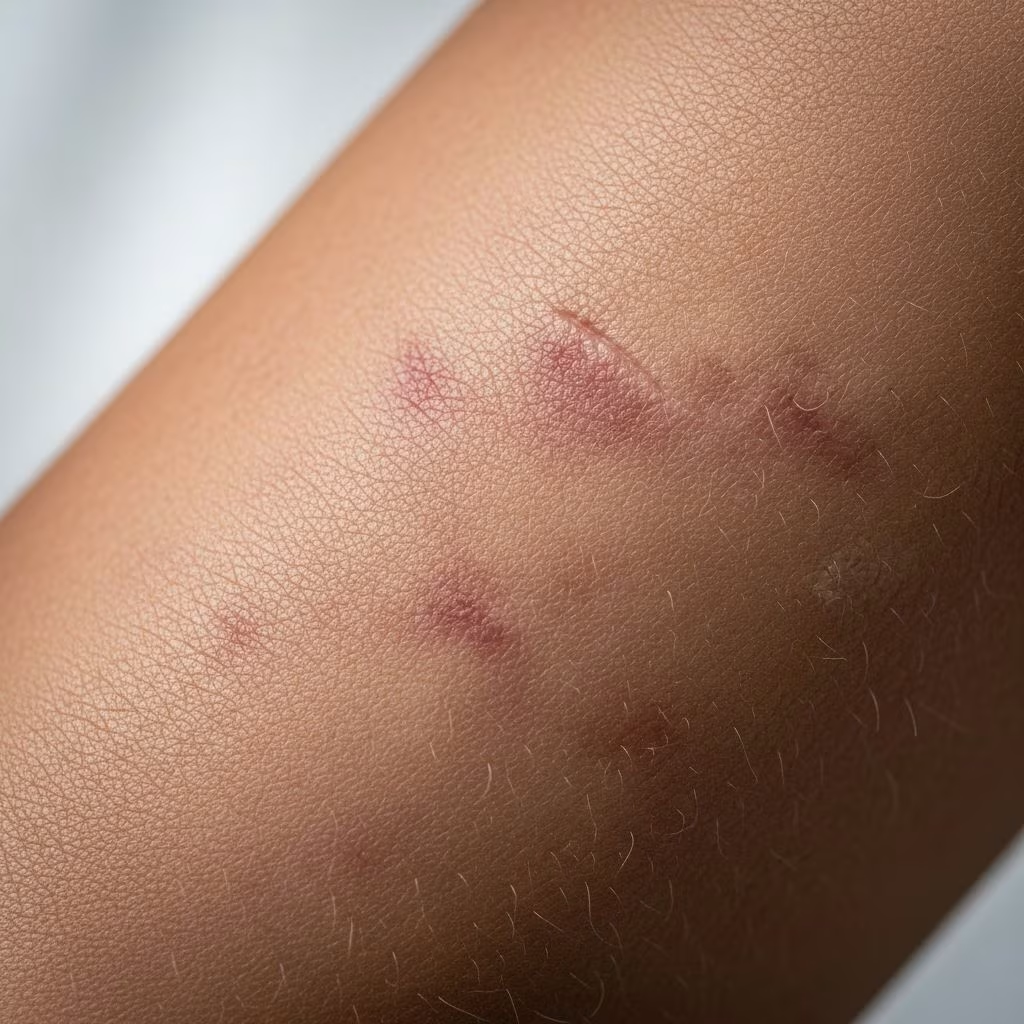
Uraemic pruritus, also known as chronic kidney disease-associated pruritus (CKD-aP), is a common and distressing symptom affecting up to 90% of patients with end-stage renal disease (ESRD) on dialysis. It manifests as generalised, intense itching without primary skin lesions, significantly impairing quality of life through sleep disruption, anxiety, depression, and increased mortality risk. This condition arises from multifactorial mechanisms including uraemic toxin accumulation, xerosis, and immune dysregulation in advanced chronic kidney disease (CKD).
What is the cause of uraemic pruritus?
The precise aetiology of uraemic pruritus remains incompletely understood but involves multiple interconnected pathways. Kidney dysfunction leads to retention of uraemic toxins such as urea, creatinine, and phosphates, which deposit in the skin and stimulate pruriceptors. Elevated parathyroid hormone (PTH), hyperphosphataemia, and secondary hyperparathyroidism exacerbate symptoms by promoting cutaneous calcification and inflammation.
Xerosis (dry skin) affects over 80% of dialysis patients, contributing to itch through impaired skin barrier function and increased transepidermal water loss. Microinflammation, evidenced by raised C-reactive protein in affected patients, plays a key role via cytokine release (IL-31, IL-6). Opioid dysregulation—an imbalance favouring μ-opioid receptor activation over κ-opioid suppression—amplifies central itch signalling.
Dialysis-related factors include bioincompatible membranes triggering complement activation, inadequate dialysis dosing (Kt/V <1.2), and high calcium-phosphate product. Other contributors encompass neuropathy from uraemic toxins affecting C-fibres, mast cell degranulation, and vitamin deficiencies (e.g., essential fatty acids).
Who gets uraemic pruritus?
Uraemic pruritus predominantly affects patients with advanced CKD stages 4–5 and ESRD, with prevalence rising from 40% in CKD to 60–90% on long-term haemodialysis. It develops after months to years of dialysis, correlating with treatment duration. Risk factors include:
- Male sex (2:1 predominance)
- Diabetes mellitus
- Older age (>60 years)
- Higher body mass index
- Longer dialysis vintage (>2 years)
- Inadequate dialysis (low Kt/V)
- Hyperphosphataemia (>1.8 mmol/L)
- Secondary hyperparathyroidism (PTH >300 pg/mL)
Peritoneal dialysis patients experience lower rates (20–50%) due to better middle-molecule clearance. Symptoms often resolve post-kidney transplantation within weeks.
What are the clinical features of uraemic pruritus?
Patients report severe, intractable itching rated 7–10/10 on visual analogue scales, worse at night and post-dialysis. Itching is typically generalised but favours the back, arms, head, and abdomen in a symmetrical, discontinuous pattern. No primary rash exists; secondary changes from excoriation include linear scratches, lichenification, and hyperpigmentation.
| Feature | Description |
|---|---|
| Distribution | Generalised; back, limbs, head/neck most affected |
| Timing | Nocturnal peak; worsens post-haemodialysis |
| Intensity | Severe (VAS >7); daily or near-daily episodes |
| Secondary signs | Excoriations, prurigo nodularis, xerosis |
Aggravators include heat, stress, showering, and physical activity; relief is minimal from scratching or antihistamines.
How is the diagnosis of uraemic pruritus made?
Diagnosis is clinical after excluding alternative pruritus causes via history, examination, and targeted investigations. Key differentials include scabies, drug eruptions, cholestatic pruritus, and atopic dermatitis.
Diagnostic criteria
- Generalised pruritus >6 weeks in CKD/ESRD patient
- No primary skin disease
- Intensity affects sleep/quality of life
- Refractory to standard antipruritics
Investigations
- Bloods: Urea, creatinine, eGFR, calcium, phosphate, PTH, ferritin, CRP, LFTs, TFTs, iron studies
- Dialysis adequacy: Kt/V, urea reduction ratio
- Skin biopsy: Rarely; shows mast cell hyperplasia, perivascular inflammation
- Others: Exclude parasites (scabies prep)
Severity tools: 5D itch scale, visual analogue scale (VAS).
What is the differential diagnosis for uraemic pruritus?
Exclude treatable mimics:
- Drug-induced: Erythropoietin, ACE inhibitors, iron salts
- Infectious: Scabies, folliculitis, hepatitis
- Systemic: Cholestasis (ALP/GGT), hyper/hypothyroidism, lymphoma, diabetes neuropathy
- Dermatological: Eczema, psoriasis, urticaria
- Psychogenic: Rare; consider if non-uraemic
What is the treatment for uraemic pruritus?
Management follows a stepwise, multimodal approach optimising CKD care alongside pruritus-specific therapies. No single agent cures; 50–70% achieve partial relief.
First-line: Correct uraemia and skin care
- Dialysis optimisation: Increase frequency/duration, high-flux membranes, Kt/V >1.4
- Phosphate/PTH control: Binders (lanthanum), cinacalcet, parathyroidectomy if severe
- Emollients: Apply liberally 2–3x daily (urea 10%, glycerol); reduce xerosis by 40%
- Baths: Cool water, emollient substitutes for soap
Second-line: Antipruritics
| Agent | Dose | Efficacy | Side effects |
|---|---|---|---|
| Gabapentin | 100–300mg post-dialysis | 60–80% response | Sedation, dizziness |
| UVB phototherapy | Narrowband 3x/week | 60–70%; superior to UVA | Erythema, tanning |
| Capsaicin 0.025–8% | Topical 4x/day | Moderate localised relief | Burning (use with menthol) |
| Sertraline/SSRI | 50–200mg daily | 50% in refractory cases | GI upset, insomnia |
Third-line: Opioid modulators
- Nalfurafine (κ-agonist): 5μg post-dialysis; 70–85% response in Japan
- Difelikefalin (IV κ-agonist): Approved for dialysis pruritus; rapid onset
Emerging/Future
Sucroferric oxyhydroxide (phosphate binder), IL-31 inhibitors, renal transplantation (resolves 80–100%).
Frequently asked questions
What causes uraemic pruritus?
Multifactorial: uraemic toxins (urea, phosphates), xerosis, dialysis inadequacy, PTH excess, opioid imbalance, and skin microinflammation.
How common is uraemic pruritus?
Affects 60–90% of long-term haemodialysis patients; less in peritoneal dialysis (20–50%).
Does uraemic pruritus go away?
Persists chronically without intervention; resolves post-transplant or optimised dialysis in 30–50%.
Can kidney transplant cure uraemic pruritus?
Yes, symptoms resolve in 80–100% within 1–2 months post-transplant.
What is the best cream for uraemic pruritus?
Emollients with urea 10% or glycerol; capsaicin for localised areas despite initial burning.
Is there a cure for dialysis itch?
No cure, but stepwise therapy (dialysis optimisation, gabapentin, UVB, κ-agonists) provides substantial relief in most.
References
- Uremic Pruritus – Causes, Diagnosis and Treatment — Apollo Hospitals. 2024. https://www.apollohospitals.com/symptoms/uremic-pruritus
- Uremic Pruritus Evaluation and Treatment — StatPearls, NCBI Bookshelf, NIH. 2023-10-01. https://www.ncbi.nlm.nih.gov/books/NBK587340/
- Uraemic Pruritus — St George Renal. 2023. https://stgrenal.org.au/for-health-professionals/learning-resources/symptom-management/uraemic-pruritus/
- Pruritus (chronic itchy skin) — National Kidney Foundation. 2024. https://www.kidney.org/kidney-topics/pruritus-itchy-skin
- Uremic Pruritus: Causes, Symptoms, Diagnosis & Treatment — Cleveland Clinic. 2023-11-27. https://my.clevelandclinic.org/health/symptoms/25049-uremic-pruritus